
Before understanding this issue, let's know what adsorbents and adsorbates are firstly.
1. Adsorbent
Adsorbents, also known as absorbents, are a type of substance with adsorption capacity, usually solid.
The characteristics of adsorbents are generally large specific surfaces and suitable porous pore structures; Strong adsorption capacity for adsorbates; Generally, there is no chemical reaction with the adsorbate and medium. There are usually three types of adsorption methods on the surface of adsorbents:
(1) Physical adsorption (intermolecular force): non selective, molecular attraction increases with increasing molecular weight; The surface energy decreases and releases heat.
(2) Chemical adsorption (chemical bonding force): A chemical reaction occurs between the adsorbent and the adsorbate.
(3) The surface energy is reduced by the aggregation of adsorbate ions and electrostatic anions on the charged points of the adsorbent surface, while releasing equivalent amounts of the same number of ions.
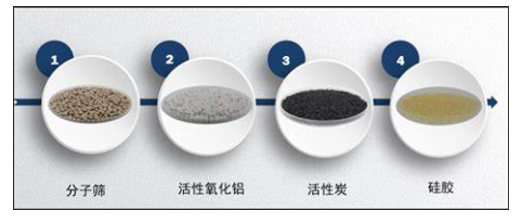
Common types of adsorbents | Application of adsorbent |
silica gel | Separation of gas mixtures and petroleum components |
Activated alumina | Dehydration adsorbent |
Activated carbon/activated carbon fiber | Water treatment, decolorization, and gas treatment |
polyacrylamide | Domestic sewage and organic wastewater |
Zeolite molecular sieve | Gas adsorption separation, gas and liquid drying |
Carbon molecular sieve | Transport channel, using micropores as molecular sieves |
Adsorption resin | Natural product extraction; Water treatment; Drug separation and extraction |
The substance adsorbed by solid materials with certain adsorption capacity is called adsorbate. The adsorbate is the object adsorbed by the adsorbent, that is, the target substance adsorbed during the adsorption process. The amount of adsorbate adsorption is related to its own solubility, molecular weight, and molecular polarity.
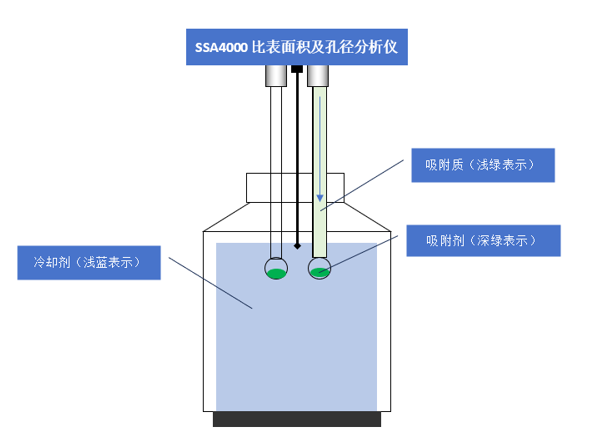
Through the above introduction, we have learned that in BET pore size analysis, the adsorbate is the adsorbed gas, such as N2/Ar/CO2/Kr, and the adsorbent is the solid sample in the test tube. As shown in the following figure,
contact
Be the first to know about our new product launches, latest blog posts and more.Any question or request?
Click below, we’ll be happy to assist. contact