

The determination of the true density of carbon materials is currently the standard method in ferrous metallurgy industry. The standard method uses a glass specific gravity bottle to add air-free distilled water, heated to boil the water to eliminate the air adsorbed on the sample, and determines the true density of the sample according to the Archimedes principle. This method is more complicated to operate, not easy to master, by the tester and environmental conditions of the impact is relatively large. Can not get very good repeatability and accuracy. ASTM standard D2638-91 (2002) stipulates that helium gas densimeter is used to determine the true density of calcined petroleum. Experiments have proved that this method is also suitable for carbon, and it is simple to operate, with good repeatability and high accuracy. At present, many carbon industries are using this method for testing.
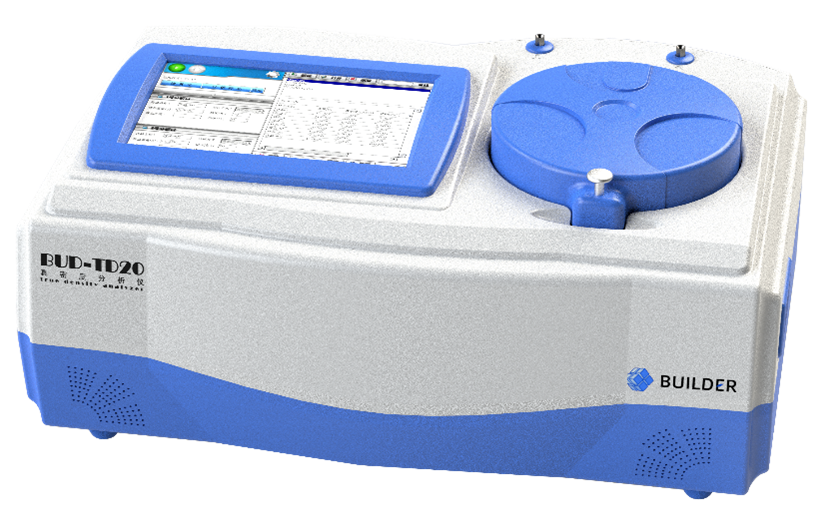
TD-2200 Helium replacement method true density meter is through the application of Archimedes principle, using small molecule diameter inert gas (generally helium) under certain conditions (constant temperature, confined space) Boyle's law (P1V1=P2V2), to determine the true volume of the sample, so as to obtain its true density, true density = mass/true volume. The condition for Boyle's law to hold is that in a constant state of temperature, a true density meter with a true constant temperature system must be used for testing. In addition, the vacuum pretreatment technology is also a necessary condition to obtain the accurate value, and the vacuum pretreatment can treat the trace amount of water in the sample pore. In addition to the instrument itself, the preparation of the sample is crucial. TD-2200 test carbon true density operation process is as follows:
1. instrument preheating
Turn on and preheat the instrument for 20-30min before testing the sample.
2. Sample preparation
The sample must be treated at 105 ° C ±2 ° C for 2 hours before loading (if the sample is blocky and uneven in volume, it is recommended to break and sift before drying). The TD-2200 comes with a vacuum pretreatment system that can remove trace amounts of moisture and impurity gases inside the sample and instrument piping to ensure more realistic data.
3. Loading sample
After processing, the sample must be cooled in the drying box, and a certain amount of sample must be weighed with a 1/10,000 electronic balance. The sample amount is slightly larger than about 2/3 of the volume of the sample pool, and the sample pool containing the sample must be loaded into the instrument.
4. Data input
Enter the sample name and quality on the instrument and start testing.
5. Equipment stability determination:
5.1 Repeatability: the TD-2200 true density instrument has been tested for more than 3 times, and the volume deviation of the data is less than 10 microliters.
5.2 Reproducibility: The same sample is resamped for testing to ensure the reproducibility of the instrument.
5.3 Parallelism: The same sample is tested in multiple analysis bins at the same time to ensure the parallelism of equipment.
contact
Be the first to know about our new product launches, latest blog posts and more.Any question or request?
Click below, we’ll be happy to assist. contact
